Self-managing your HOA works until it doesn't. Many communities start with capable, enthusiastic volunteers who handle operations effectively for years. But circumstances change. Board members move away, workloads increase, regulations get more complex, and the volunteers who once had bandwidth start running on fumes.
The question isn't whether self-management can work. It can. The question is whether it's still working for your community right now. Here are the signs that it might be time to make a change.
The Warning Signs Are Usually Obvious in Hindsight
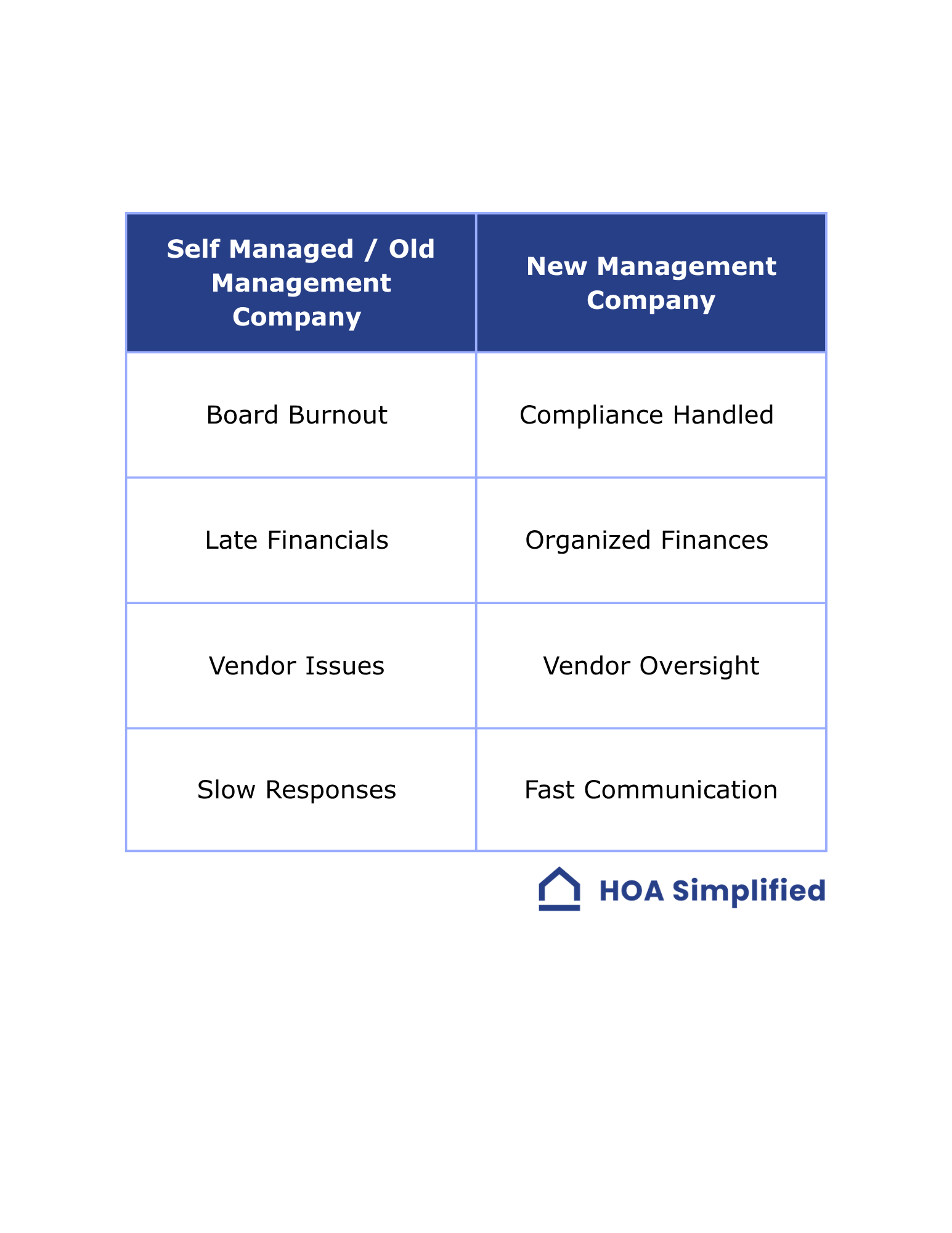
Board burnout rarely happens overnight. It builds gradually, and the signs are easy to rationalize away. But when several appear at once, they point to a systemic problem.
Volunteer fatigue is spreading. The same two or three people handle everything. Other board members have checked out. Recruiting new volunteers has become nearly impossible.
Compliance obligations are slipping. Required disclosures are late. Meeting notices go out without proper lead time. The board is vaguely aware that state law changed recently, but nobody has had time to figure out what it means.
Financial records are behind. Bank reconciliations haven't been completed in months. The budget was copied from last year with minimal adjustments. Nobody is entirely sure which homeowners are delinquent.
Homeowner complaints are increasing. Response times have gotten slower. Enforcement is inconsistent because different board members interpret the rules differently.
Vendor relationships are unmanaged. Contracts auto-renew without review. Work quality has declined, but nobody has time to solicit new bids.
If three or more of these apply to your community, self-management is costing you more than professional support would.
Recognizing these signs in your community? Talk to Our Team
What Professional Management Actually Handles
Professional management is not just "hiring someone to do paperwork." A competent firm handles financial administration (billing, collections, reporting, tax coordination), compliance oversight, vendor coordination, homeowner communications, and board support (agendas, meeting attendance, strategic guidance).
The board still makes decisions. A management company handles execution.
The Hidden Costs of Self-Management
Many boards resist professional management because of the fees. That's understandable. But self-management has its own costs, and they're easy to undercount.
Volunteer time has value. If three board members each spend 10 hours per month on HOA tasks, that's 360 hours annually of unpaid labor. At any reasonable hourly rate, that figure rivals or exceeds management fees.
Mistakes are expensive. A missed tax filing, an improper lien, a botched election, or an uninsured vendor incident can cost the association thousands of dollars in penalties, legal fees, or settlements. Professional firms have systems designed to prevent these errors.
Deferred maintenance compounds. When boards are stretched thin, maintenance gets postponed. A $5,000 repair today becomes a $25,000 emergency next year.
Vendor pricing suffers. Professional management companies manage dozens or hundreds of communities. That volume gives them negotiating leverage with vendors that individual self-managed HOAs cannot match.
When you account for volunteer time, error costs, deferred maintenance, and lost vendor savings, self-management often costs more than the management fee it's trying to avoid.
How to Evaluate Management Companies
Not all management companies are equal. If you decide to transition, invest time in finding the right partner.
Ask about their portfolio. How many communities do they manage? A company experienced with communities similar to yours will onboard faster and deliver better results.
Examine their technology. Modern firms offer online portals for homeowners, real-time financial reporting, and digital communication tools. If a company still operates on spreadsheets, keep looking.
Check references. Talk to current client boards. Ask about responsiveness, financial accuracy, and how the company handles difficult situations.
Understand the fee structure. Management fees typically range from $10 to $25 per unit per month. Make sure you understand what's included and what triggers additional charges.
Assess cultural fit. Communication style, responsiveness, and shared values matter as much as technical competence.
What a Smooth Transition Looks Like
Switching from self-managed to professional management is less disruptive than most boards expect. A well-organized transition typically takes 30 to 60 days.
Weeks 1 through 2: The management company reviews your governing documents, financial records, vendor contracts, and homeowner files.
Weeks 3 through 4: Bank accounts are set up or transferred. Accounting systems are configured. Vendors are introduced to the new team.
Weeks 5 through 8: The management company assumes day-to-day operations. Homeowners receive updated contact information and payment instructions. The board shifts from executing tasks to overseeing strategy.
The key to a smooth transition is complete document transfer. Organized records accelerate onboarding significantly.
Making the Decision
Deciding to hire a management company is not an admission of failure. It's a recognition that your community's needs have evolved beyond what volunteers can sustainably provide. The boards that make this transition proactively, before a crisis forces their hand, consistently report better outcomes.
Your volunteers' time and energy are finite resources. Redirecting that energy from administrative tasks to strategic oversight makes the entire board more effective, and your homeowners benefit from professional-grade operations and reliable financial management.
If your board is ready to explore what professional support looks like, start with a conversation. The right partner will listen first, understand your community's needs, and show you exactly how the transition would work.