Parking violations rank among the most frequent HOA compliance issues. Effective handling requires clear policies, consistent enforcement, and fair procedures that protect community interests while respecting homeowner rights.
Common HOA Parking Restrictions
Most associations implement parking rules to ensure adequate space and maintain aesthetic standards. Understanding common restrictions helps both boards and residents.
Assigned space requirements prevent overcrowding. Many communities allocate specific spaces to units. Parking in another resident's assigned space creates immediate conflicts.
Guest parking limitations ensure availability. Restrictions on guest space duration prevent residents from storing vehicles long-term in visitor areas. Typical limits range from 24 to 72 hours.
Commercial vehicle prohibitions maintain residential character. Large trucks, work vans with signage, and commercial trailers often face restrictions. These rules protect property values and neighborhood aesthetics.
Street parking regulations address safety and access. Fire lanes, emergency vehicle access, and sight line clearance require enforcement. Some communities prohibit street parking entirely.
Ready to simplify your HOA? Request a Proposal
Creating Effective Parking Policies
Well-designed policies prevent violations through clarity. Vague rules create confusion and enforcement challenges.
Specific language eliminates interpretation disputes. Rather than "no oversized vehicles," specify "no vehicles exceeding 20 feet in length or 7 feet in height." Measurable standards enable objective enforcement.
Visual aids improve compliance. Parking maps showing assigned spaces, guest areas, and restricted zones help residents understand rules. Signage reinforces policies at critical locations.
Reasonable restrictions gain better acceptance. Policies should address legitimate community needs without unnecessary burden. Overly restrictive rules generate resentment and non-compliance.
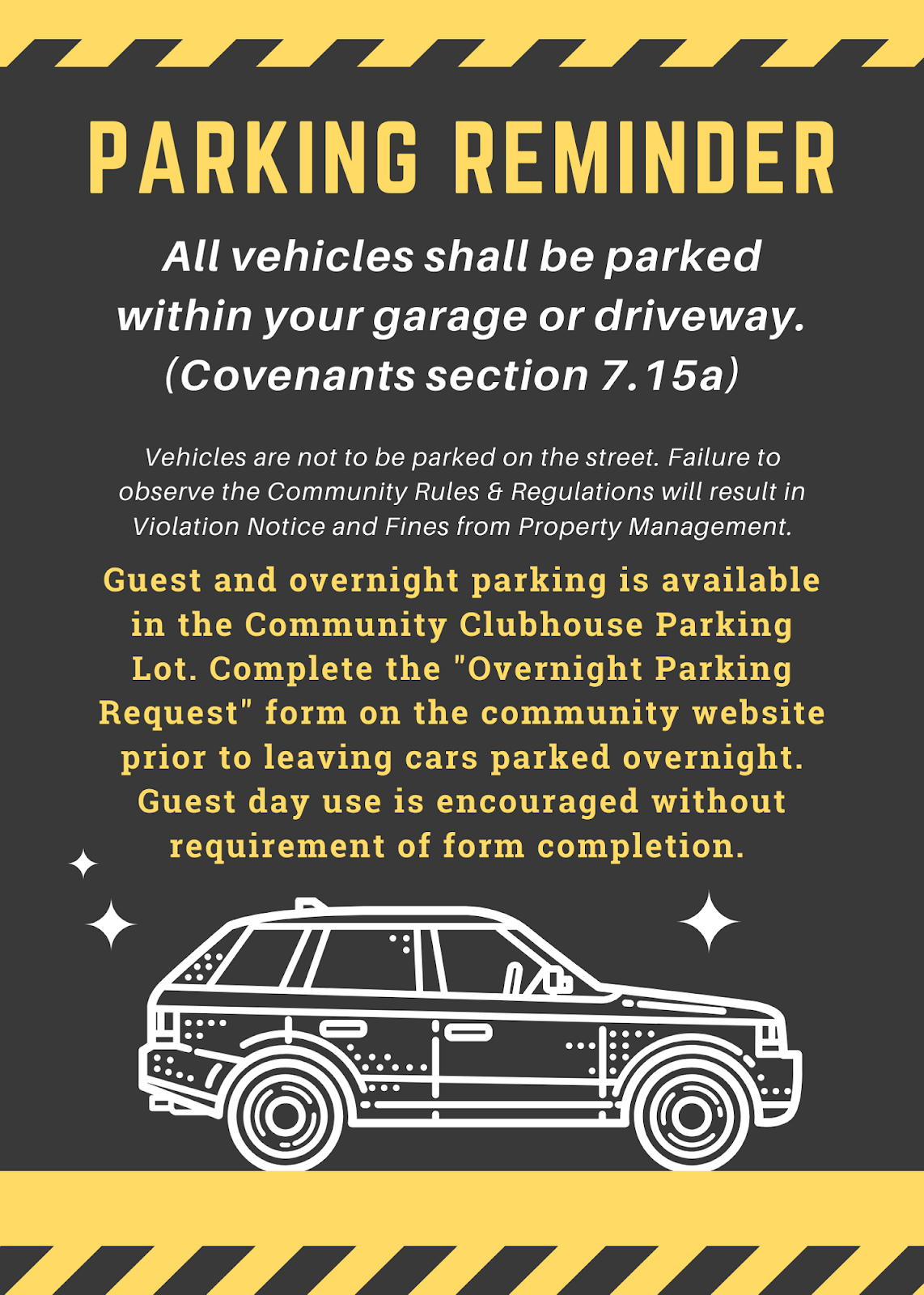
See below for a sample guest parking policy sent out to homeowners by Remington HOA:
Enforcement Procedures
Consistent enforcement maintains policy credibility and prevents discrimination claims. Boards should establish clear procedures and follow them uniformly.
Documentation begins the process. Violation notices should include date, time, location, specific rule violated, and photographic evidence. Detailed records support enforcement if disputes arise.
Progressive penalties encourage compliance. First violations typically warrant warnings. Subsequent violations escalate to fines, towing, or other consequences. Graduated responses provide correction opportunities.
Reasonable timeframes allow correction. Notice should specify violation details and deadline for compliance. Immediate towing suits only serious safety issues like fire lane blocking.
Warning Notices
Initial warnings serve educational purposes. Many violations stem from ignorance rather than intentional disregard.
Warnings should clearly state the violation with specific policy references. Include CC&R or rule section numbers so residents can verify restrictions. Ambiguity undermines enforcement.
Provide correction deadlines appropriate to violation type. Moving a vehicle from a fire lane requires immediate action. Removing unauthorized long-term storage might allow 24-48 hours.
Document all warnings carefully. Records establish violation history if further action becomes necessary. Dated photos and written notices create defensible enforcement trails.
Fine Assessment
Monetary fines deter repeat violations when warnings prove insufficient. However, fine authority requires proper legal foundation.
Verify governing documents authorize fines. CC&Rs or bylaws must grant boards fine assessment power. Lacking this authority, boards cannot impose monetary penalties.
Follow due process requirements. California and many states mandate violation hearings before fine imposition. Residents must receive adequate notice and opportunity to present their case.
Set reasonable fine amounts. Excessive penalties face legal challenges. Fines should encourage compliance without creating undue hardship. Many associations use graduated scales from $25 to $500 based on severity and frequency.
Towing Policies
Towing represents serious enforcement appropriate only for specific circumstances. Improper towing creates liability and damaged community relationships.
Reserve towing for safety issues and extreme violations. Fire lane blocking, emergency access obstruction, and dangerous parking justify immediate removal. Convenience violations rarely warrant towing.
Provide clear towing notice requirements. Most jurisdictions require posted warning signs specifying towing authority, company name, and contact information. Verify local regulations before implementing towing.
Use reputable towing companies with proper insurance. Establish written agreements specifying authorization procedures and liability coverage. Document all towing authorizations carefully.
Violation Hearings
Hearings provide due process and help boards make informed decisions. Fair procedures protect associations from legal challenges.
Notice must specify alleged violation, proposed penalty, hearing date and time, and resident rights. Provide adequate notice periods as required by governing documents or state law.
Allow residents to present evidence and testimony. Residents may explain circumstances, dispute facts, or request penalty modification. Boards should listen genuinely and consider information presented.
Document hearing proceedings. Meeting minutes should record attendees, evidence presented, discussion points, and final decisions. Thorough documentation proves fair procedures if disputes escalate.
Special Circumstances
Temporary situations sometimes require accommodation. Rigid enforcement without considering context damages community relationships.
Construction and moving activities require parking flexibility. Temporary dumpsters, contractor vehicles, and moving trucks necessarily violate normal rules. Reasonable advance notice and time limits address these situations.
Disability accommodations must receive consideration. Residents with mobility limitations may need parking proximity beyond normal allocation. Fair Housing Act requires reasonable modifications.
Emergency situations justify temporary violations. Medical emergencies, vehicle breakdowns, and similar crises warrant leniency. Boards should exercise judgment when circumstances justify flexibility.
Appeal Processes
Appeal procedures ensure fairness and provide checks on enforcement decisions. Clear processes protect both associations and residents.
Specify appeal deadlines and procedures. Residents should receive written information about appeal rights with violation notices. Typical appeal periods range from 10 to 30 days.
Designate appeal review authority. Some boards hear appeals directly. Others use dispute resolution committees or independent arbitrators. Separation from initial decision-makers increases fairness.
Consider new evidence fairly. Appeals may present information unavailable during initial proceedings. Genuine consideration of additional facts demonstrates commitment to justice.
Technology Solutions
Modern technology improves parking compliance and enforcement. Various tools help associations manage parking more effectively.
Permit systems identify authorized vehicles. Hanging tags, window decals, or electronic permits distinguish resident vehicles from unauthorized parking. Visual identification simplifies enforcement.
License plate registration allows automated monitoring. Some associations maintain databases of authorized vehicles. Security or patrol services can quickly verify parking legitimacy.
Digital documentation streamlines enforcement. Mobile apps enable staff to photograph violations, record details, and generate notices instantly. Cloud storage maintains organized violation records.
Prevention Through Communication
Proactive communication reduces violations. Education proves more effective than enforcement.
Distribute parking rules at move-in. New residents should receive comprehensive rule summaries including parking policies. Early education prevents inadvertent violations.
Periodic reminders maintain awareness. Newsletter articles, community emails, and posted notices keep parking rules visible. Gentle reminders encourage compliance.
Address emerging issues promptly. If new violation patterns develop, communicate concerns before implementing strict enforcement. Residents appreciate opportunities to correct behavior voluntarily.
Maintaining Community Relations
Parking enforcement affects community atmosphere. Balance policy enforcement with relationship preservation.
Apply rules consistently regardless of personal relationships. Selective enforcement breeds resentment and legal vulnerability. Uniform application maintains credibility.
Remain professional during enforcement. Emotional or confrontational approaches escalate conflicts. Factual, respectful communication produces better outcomes.
Recognize that volunteers enforce policies. Board members deserve respect even when residents disagree with decisions. Personal attacks damage community spirit.
Effective parking enforcement protects community interests while treating residents fairly. Clear policies, consistent procedures, and respectful communication create compliance without unnecessary conflict.