Governing documents are the foundation of every HOA. They define rules, responsibilities, and how the community operates. But communities change and laws evolve. What made sense when the developer drafted your CC&Rs twenty years ago may no longer serve the community today. Amending your governing documents is the formal process for keeping them current, enforceable, and aligned with how your community actually functions.
When Amendments Are Needed
Not every frustration with a rule requires an amendment, but certain situations make the case clearly.
Outdated provisions are the most common trigger. Many CC&Rs still reference technologies, building materials, or community standards that no longer apply. Rules written before solar panels, electric vehicles, or modern telecommunications often need updates.
Changes in state or federal law can make existing provisions unenforceable or illegal. When legislation conflicts with your governing documents, the law takes precedence. But relying on that default creates confusion. Amending the documents to reflect current law eliminates ambiguity.
Community growth also drives amendments. A community that started as 50 homes and grew to 200 may need different quorum requirements, assessment structures, or architectural standards.
The Difference Between CC&Rs, Bylaws, and Operating Rules
Before you begin, understand what you are actually changing. Each document type serves a different purpose and follows different rules for modification.
CC&Rs (Covenants, Conditions, and Restrictions) are the primary governing documents recorded against the property. They define use restrictions, maintenance obligations, and architectural standards. CC&Rs are the hardest to amend because they typically require a supermajority vote of the membership.
Bylaws govern internal operations: board structure, meeting procedures, election rules, and officer duties. Bylaws usually require a membership vote but may have a lower threshold than CC&Rs.
Operating rules and policies address day-to-day matters like pool hours, parking, and pet policies. These can usually be adopted or changed by the board without a full membership vote, though most states require advance notice to homeowners.
Voting Thresholds Required
The required approval depends on your governing documents and state law. In California, CC&R amendments typically require approval from at least 67% of the membership (not just those who vote, but 67% of all owners). Bylaw amendments often require a simple majority, though your documents may specify otherwise.
Always check your existing CC&Rs and bylaws for the exact requirements. Some older documents require unanimous consent for certain changes, which can make specific amendments practically impossible without a court petition.
If your community struggles to reach the threshold due to voter apathy rather than opposition, some states offer reduced voting procedures. California's Civil Code allows associations to petition the court for approval when they cannot reach the required percentage despite good-faith efforts.
Step-by-Step Amendment Process
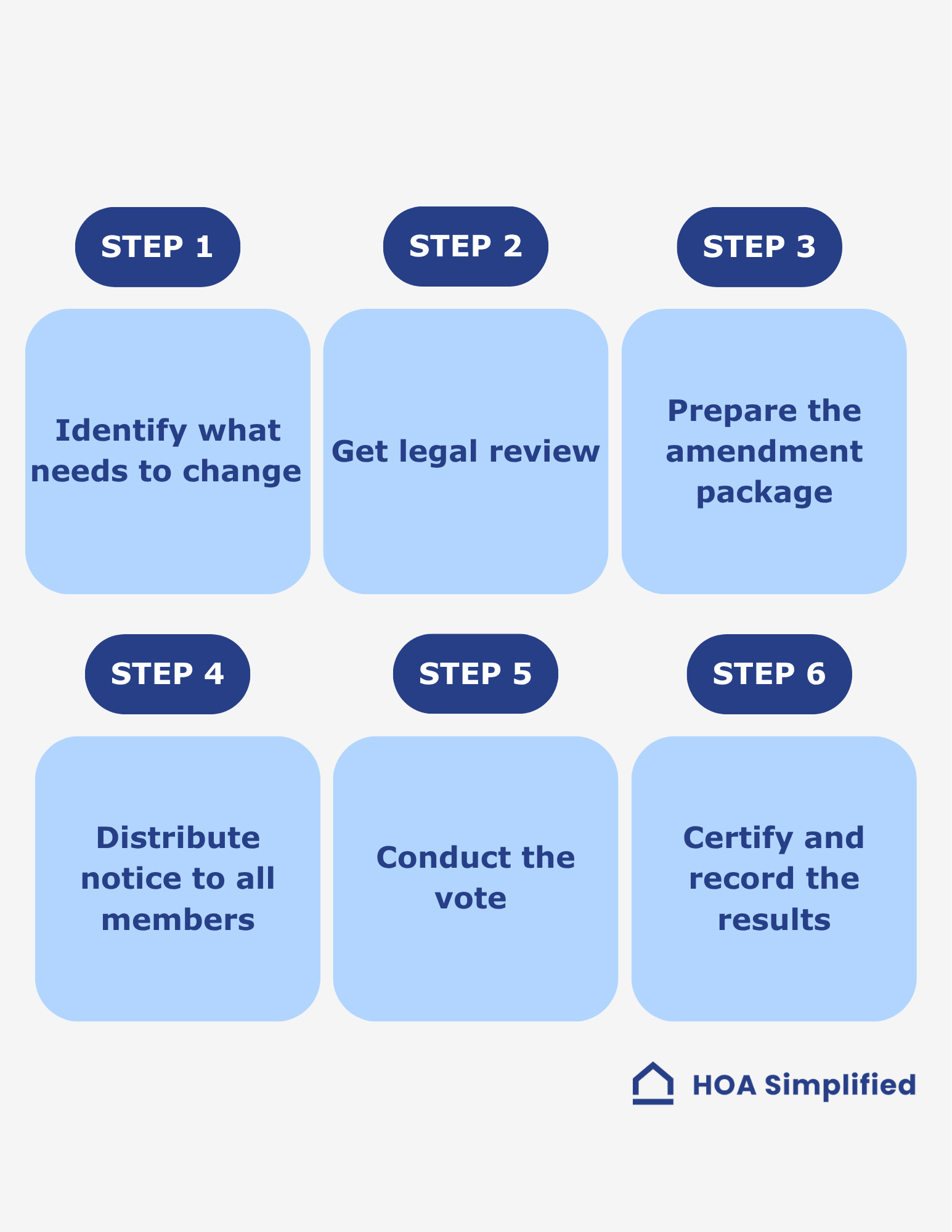
Rushing any step risks invalidating the entire effort.
Step 1: Identify what needs to change. Draft the specific language you want to add, remove, or modify. Be precise. Vague amendments create more problems than they solve.
Step 2: Get legal review. An HOA attorney can confirm the amendment complies with state law, does not conflict with other provisions, and will hold up if challenged.
Step 3: Prepare the amendment package. Include the exact proposed language, a plain-language explanation of what changes and why, a comparison of old and new text, and voting materials with clear instructions.
Step 4: Distribute notice to all members. State law and your governing documents specify how much notice is required. Thirty to sixty days is common.
Step 5: Conduct the vote. Follow your bylaws for membership votes. This typically involves ballots distributed by mail or electronically, a set voting period, and independent ballot counting.
Step 6: Certify and record the results. If the amendment passes, certify the vote and record the amended documents with the county recorder's office.
Need guidance through the amendment process? Request a Proposal
Member Notice Requirements
Proper notice is both a legal requirement and a practical necessity. Homeowners who feel blindsided by proposed changes are far more likely to vote against them.
Start communicating early. Before the formal notice period begins, introduce the proposed amendments at board meetings, in newsletters, and through community forums. Explain the reasoning and answer questions. Give homeowners time to process the changes before they receive a ballot.
During the formal notice period, comply strictly with your state's requirements. In many states, notices must be sent by first-class mail. Cutting corners on notice gives opponents grounds to challenge the amendment even after it passes.
Recording and Cost Considerations
An amendment is not effective until it is properly recorded with the county recorder's office. The recorded document should include the amendment text, a certification of the vote results, signatures of authorized board officers, and any required notarization.
As for costs, legal review is the largest expense. Fees for drafting or reviewing amendment language and ensuring compliance with state law can range from a few thousand dollars to significantly more for comprehensive restates. Administrative costs include printing and mailing amendment packages and ballot materials. Recording fees vary by county but are generally modest. Budget for the amendment process as a line item so it does not strain the operating budget.
Common Amendments Boards Make
Certain amendments come up frequently across communities. Updating architectural standards for solar panels, EV charging, and modern building materials. Revising assessment and collection procedures to align with current law. Modifying rental and leasing restrictions as community priorities shift. Adjusting quorum requirements when low participation makes meetings difficult. Removing developer-era provisions that no longer apply.
The best amendments solve real problems that homeowners already recognize. When the community understands why a change matters, reaching the required voting threshold becomes much more achievable.