Most HOA boards make decisions based on gut feelings and anecdotal evidence. Someone mentions that vendor responses seem slower lately. A board member thinks delinquencies might be increasing. The treasurer feels like maintenance costs are creeping up.
These impressions might be accurate. Or they might be completely wrong. Without data, you're managing your community blindfolded.
Key Performance Indicators (KPIs) transform HOA governance from reactive crisis response to proactive strategic planning. Think of them as your community's vital signs. They reveal what's actually happening with your finances, operations, and homeowner satisfaction.
You Don't Need Fancy Tools
The sophistication of your tracking system matters far less than consistency in measuring what's important. A simple spreadsheet updated monthly beats elaborate software that nobody uses.
Start small. Pick three to five KPIs aligned with your community's current priorities. Track them consistently. Review the trends at each board meeting. Add more metrics only after you've established the habit of regular monitoring.
Complex systems fail because they demand too much time from volunteer board members. Simple systems succeed because they're sustainable. Choose sustainability.
Ready to simplify your HOA? Request a Proposal
Financial KPIs: Know Your Numbers
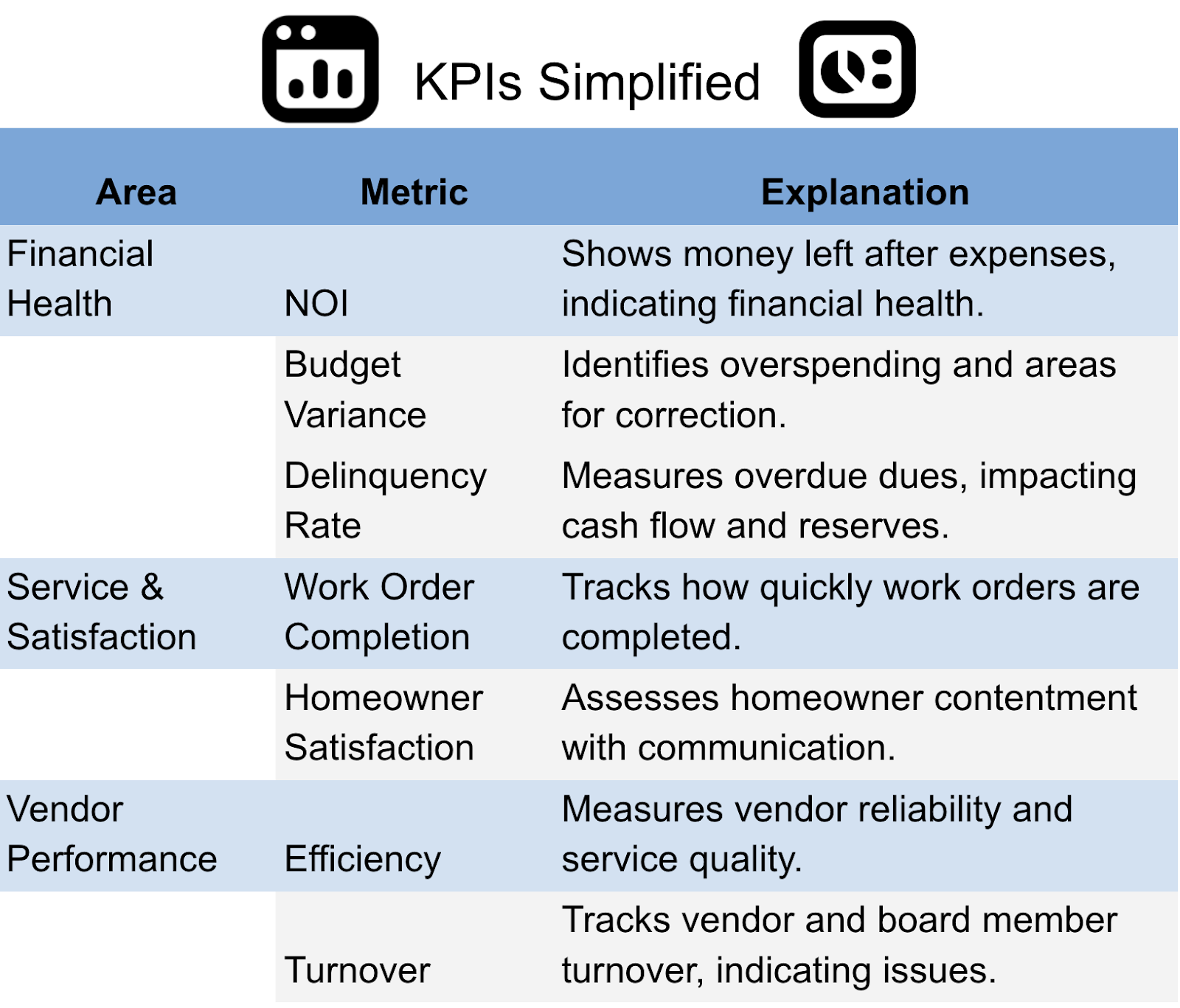
Net Operating Income (NOI) tells you what remains after you've paid all operating expenses. This metric reveals whether your community is living within its means or slowly draining reserves to cover ordinary costs.
Calculate NOI monthly. Track the trend over time. Declining NOI indicates you're either spending more than planned or collecting less revenue than expected. Either way, you need to investigate and adjust before the problem becomes a crisis.
Budget variance shows the gap between what you planned to spend and what you actually spent. Small variances are normal. Large or persistent variances signal problems with either your budgeting process or your spending controls.
Review budget variance by category. Maybe landscape costs consistently run over budget, indicating you need to renegotiate your contract or adjust future budgets. Perhaps insurance premiums came in lower than expected, creating an opportunity to allocate those savings elsewhere.
Delinquency rate measures the percentage of homeowners behind on assessment payments. This directly impacts your cash flow and ability to pay community obligations.
Track both the percentage of homeowners who are delinquent and the total dollar amount owed. A rising delinquency rate warns you about potential collection problems before they become severe. It might also indicate broader economic issues affecting your community that require board attention.
Operational KPIs: Measure What You Manage
Work order completion time averages how long maintenance requests take from submission to resolution. This metric directly affects homeowner satisfaction and community condition.
Track completion time by request type. Emergency repairs should resolve faster than routine maintenance. If your average completion times creep upward, investigate whether your vendors are overwhelmed, your processes are inefficient, or you need additional support.
Long completion times frustrate homeowners and allow small problems to become big ones. A slow leak becomes water damage. A minor electrical issue becomes a safety hazard. Monitoring this KPI helps you maintain both homeowner satisfaction and property condition.
Vendor performance assessment evaluates the reliability and effectiveness of your contractors. Create simple scorecards rating vendors on response time, work quality, communication, and adherence to budget.
Review vendor performance quarterly. Mediocre vendors don't improve on their own. If a contractor consistently underperforms, you need to address it directly or find a replacement. Your community deserves reliable service.
Community Engagement KPIs: Listen to Residents
Homeowner satisfaction is harder to quantify than financial metrics, but it's equally important. Dissatisfied residents create board conflicts, undermine community cohesion, and sometimes trigger legal disputes.
Survey homeowners annually at minimum. Ask about communication effectiveness, maintenance quality, board responsiveness, and overall satisfaction with community living. Track these results year-over-year to identify trends.
Pay attention to response rates too. Low survey participation might indicate homeowner apathy or communication failures. Either way, it's information you need.
Monitor meeting attendance and homeowner comment frequency. Engagement isn't always positive, but it beats apathy. Rising attendance at board meetings might signal controversy, or it might indicate homeowners feel more invested in community governance.
Email open rates and response times to homeowner inquiries also reveal engagement levels. If nobody reads your communications, you have a messaging problem to solve.
Track Trends, Not Just Data Points
Single measurements tell you little. A snapshot of your delinquency rate in March doesn't reveal whether things are improving or deteriorating. You need context.
Track every KPI over time. Create simple line graphs showing six months or a year of data. Trends reveal the real story. Is your NOI declining gradually? Are work order completion times creeping upward? Is homeowner satisfaction slipping?
Trend analysis enables proactive responses. You can spot problems developing and address them before they become crises. You can identify what's working and do more of it. You can make decisions based on reality rather than assumptions.
Review KPIs Regularly
Metrics only help if you actually look at them. Build KPI review into every board meeting. Spend 10 minutes examining your key metrics and discussing what they reveal.
Ask why when you see changes. Don't just note that budget variance increased; investigate what drove the change. Don't simply observe that delinquencies dropped; understand what caused the improvement so you can maintain it.
Share relevant KPIs with homeowners. Transparency about financial health, operational efficiency, and community trends builds trust. It also helps residents understand the reasoning behind board decisions.
Adjust Your Metrics as Priorities Change
The right KPIs for your community today might not be the right ones two years from now. If you're currently focused on reducing delinquencies, track collection metrics closely. Once you've resolved that issue, you might shift attention to vendor performance or capital project completion.
Reassess your KPI selection annually. Do these metrics still align with your community's priorities? Are you tracking things that actually inform decisions? Are there emerging issues that need measurement?
KPIs should serve your governance, not become bureaucratic busywork. If a metric doesn't help you make better decisions, stop tracking it and focus on what matters.
Making Decisions with Data
The point of tracking KPIs isn't creating pretty spreadsheets. It's making better decisions for your community.
When you're evaluating whether to switch vendors, review their performance data. When you're setting next year's budget, analyze spending trends and budget variances. When you're considering policy changes, look at homeowner satisfaction data and community engagement metrics.
Data doesn't make decisions for you. But it gives you the information needed to make informed choices rather than guessing. It helps you explain decisions to homeowners with concrete evidence. It enables you to course-correct quickly when something isn't working.
Your community deserves thoughtful, strategic leadership. KPIs give you the tools to provide it.