The Corporate Transparency Act changes federal reporting requirements for homeowners associations nationwide. Most HOAs must now disclose ownership information to the federal government or face substantial penalties.
If your board hasn't filed yet, you're likely behind schedule. Here's everything you need to know about CTA compliance in 2025.
What the Corporate Transparency Act Requires
The CTA targets financial crimes by requiring "reporting companies" to disclose beneficial ownership information. Most HOAs qualify as reporting companies unless they hold 501(c)(3) nonprofit status.
Very few HOAs qualify for that exemption. If you're unsure about your tax status, assume you need to file.
Information You Must Submit
Your beneficial ownership report includes organizational details and individual information about decision-makers:
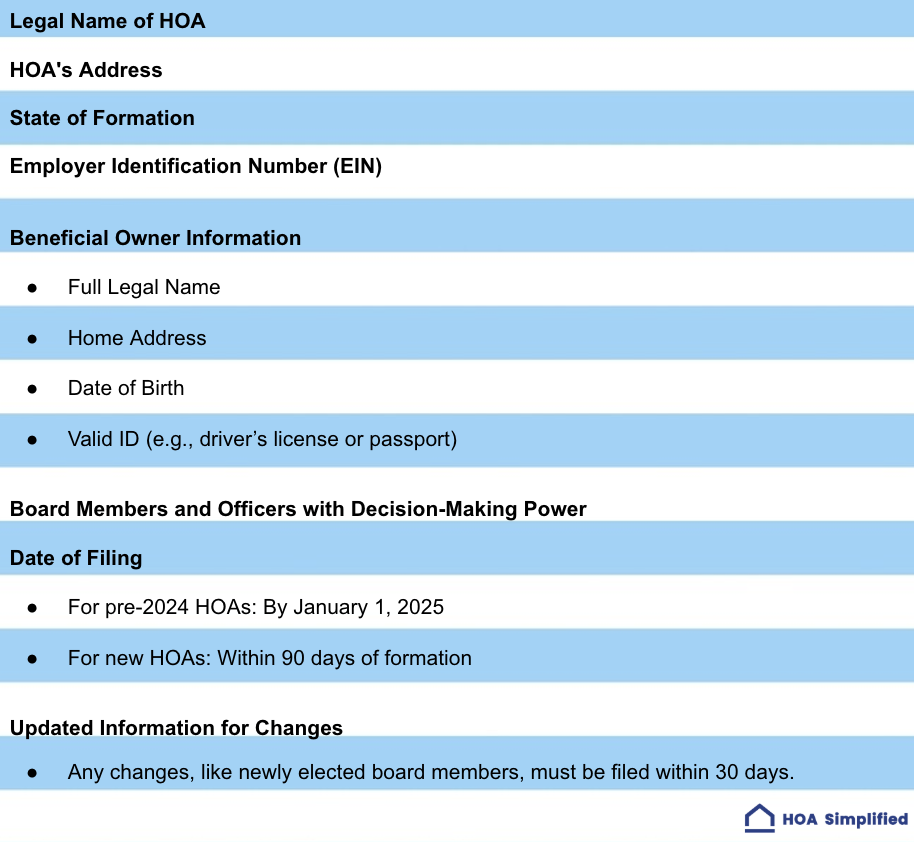
Organizational Information:
- Legal name and any alternative names
- Physical address (not a PO box)
- State or jurisdiction where formed
- Employer Identification Number (EIN)
Beneficial Owner Information: For each board member and officer with substantial decision-making authority:
- Full legal name
- Date of birth
- Current residential address
- Copy of valid government-issued identification (driver's license, passport, or state ID)
Beneficial owners typically include your board president, treasurer, secretary, and any other officers who control financial decisions or major community actions.
Seen below is a non-exhaustive list of items you'll need to file:
Critical Filing Deadlines
The CTA imposes different deadlines based on when your HOA was formed:
For HOAs formed before 2024: The deadline was January 1, 2025. If you haven't filed, you're already late and should submit immediately to minimize penalty exposure.
For newly formed HOAs: You have 90 days from formation to file your initial report.
For board changes: When beneficial owners change (new board members elected, officers appointed, or existing leaders resign), you must update your filing within 30 days.
That last requirement catches many boards off guard. Annual elections trigger mandatory updates. Officer transitions require immediate reporting. Tracking these changes becomes an ongoing compliance obligation.
Penalties for Non-Compliance
The federal government treats CTA violations seriously:
Civil penalties: $500 per day for each violation. A missed filing accumulates daily fines that quickly reach thousands of dollars.
Criminal penalties: Willful violations can result in fines up to $10,000 and imprisonment for up to two years.
These aren't theoretical risks. The federal government created this law to combat money laundering and financial crimes. Enforcement will be aggressive, and "we didn't know" won't shield your board from liability.
Who Files on Behalf of Your HOA
Board members typically handle CTA filings directly or delegate to professionals who assist with compliance paperwork. Either approach works, but someone must take ownership of the process.
If you engage professionals for financial or compliance support, ask whether CTA filing assistance is included. Many service providers now offer this as part of their compliance packages.
Need help with CTA compliance? Get Expert Guidance
Common Questions About CTA Compliance
Do we really have to include personal addresses?
Yes. Beneficial owner reports require current residential addresses for all individuals with substantial control. This information goes to the Financial Crimes Enforcement Network (FinCEN), not public databases.
What if our board members refuse to provide information?
Board service requires compliance with legal obligations. Members who refuse to provide necessary information for CTA filing may need to resign from positions of authority.
Can we file once and forget about it?
No. Updates are required within 30 days whenever beneficial ownership changes. Most HOAs will file annual updates after elections, plus interim updates when officers change mid-term.
What happens if we filed incorrectly?
File a corrected report as soon as you discover errors. Prompt correction demonstrates good faith compliance and may reduce penalty exposure.
How to File Your CTA Report
FinCEN provides an online filing system at fincen.gov. You'll create an account, enter organizational information, add beneficial owner details, and upload identification documents.
The process takes 30-60 minutes for most HOAs with standard board structures. More complex governance arrangements require additional time to identify all beneficial owners correctly.
Before starting, gather:
- Your HOA's formation documents
- EIN documentation
- Current list of all board members and officers
- Residential addresses and birthdates for each beneficial owner
- Digital copies of government IDs for all beneficial owners
Having everything organized before you start makes filing straightforward and reduces errors.
Beyond Initial Compliance
CTA filing isn't a one-time event. Your board needs systems to:
Track beneficial ownership changes: When elections happen or officers transition, someone must trigger the 30-day update process.
Maintain documentation: Keep copies of all filed reports, supporting documents, and confirmation receipts.
Monitor regulatory updates: FinCEN may modify requirements, filing procedures, or disclosure obligations. Stay informed about changes that affect ongoing compliance.
Building these systems now prevents scrambling later when updates come due.
Why This Matters for Your Community
CTA compliance protects your board from personal liability and shields your community from federal penalties. The time investment is modest. The consequences of non-compliance are severe.
If you formed your HOA before 2024 and haven't filed yet, make this your immediate priority. If your HOA is current but hasn't built systems for ongoing updates, address that gap now.
Federal compliance isn't optional, and penalties don't respect good intentions. File correctly, update promptly, and maintain documentation that proves your community takes these obligations seriously.
Your board has enough to manage without adding federal penalties to the list. Get CTA compliant and stay that way.