Running a homeowners association in California means navigating one of the most detailed regulatory frameworks in the country. The Davis-Stirling Common Interest Development Act governs virtually every aspect of HOA operations, from how meetings are conducted to how financial records are maintained. Staying compliant is not optional: it protects your community and your board from costly legal disputes.
This guide breaks down the key compliance requirements your board needs to address in 2025.
Understanding the Davis-Stirling Act
The Davis-Stirling Act, codified in California Civil Code Sections 4000 through 6150, is the primary body of law governing common interest developments. It establishes rules for governance, elections, assessments, maintenance, dispute resolution, and homeowner rights.
Every board member should have a working familiarity with this statute. Ignorance of the law does not shield a board from liability, and noncompliance can result in fines, lawsuits, or even personal liability for directors in extreme cases.
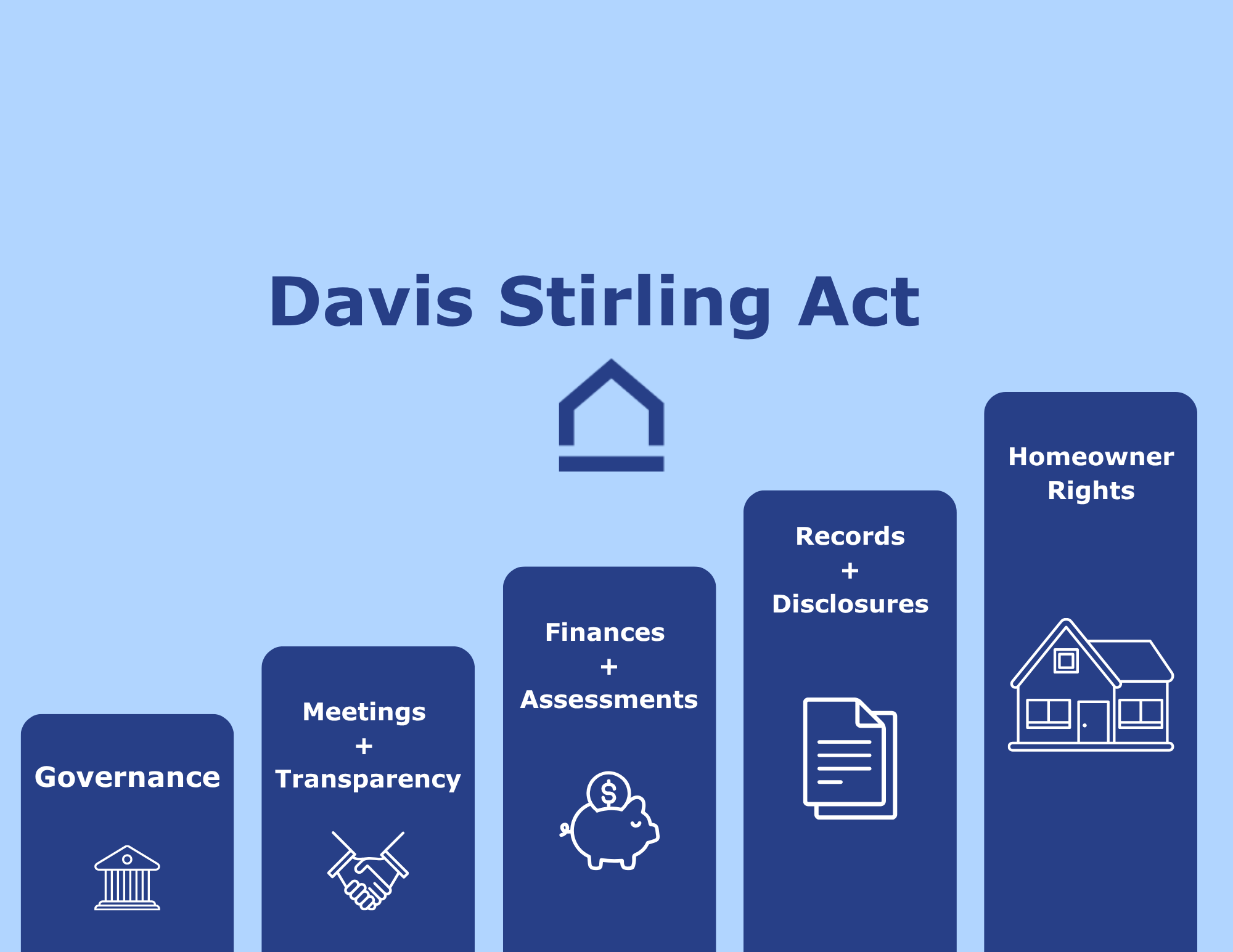
Key areas the Act covers include:
- Governing document hierarchy: how CC&Rs, bylaws, and rules interact with state law
- Open meeting requirements: notice periods, agenda rules, and executive session limitations
- Assessment collection procedures: caps on regular and special assessments without a membership vote
- Record-keeping and disclosure obligations: what must be provided to homeowners and when
- Election procedures: secret ballot requirements, inspector of elections, and candidate qualifications
Annual Disclosure Requirements
One of the most commonly overlooked compliance obligations is the annual disclosure package. California Civil Code Section 4525 requires every HOA to distribute a set of documents to all members between 30 and 90 days before the end of the fiscal year. This package must include:
- The annual budget report (or a summary)
- The reserve funding disclosure summary
- The assessment and reserve funding policy
- Insurance coverage summaries
- A statement describing the HOA's discipline policy and schedule of penalties
- A copy of the minutes from the most recent annual meeting
Failing to distribute these disclosures can expose the board to legal challenges and undermine homeowner trust. Many boards delegate this task to their partner company, but the legal obligation rests with the board itself.
Ready to simplify your HOA? Request a Proposal
New Legislation Taking Effect in 2025
California legislators continue to refine HOA law each year. Several bills signed into law affect associations starting in 2025:
- Expanded election transparency rules: Additional requirements for how ballots are counted and results reported to the membership.
- Updated reserve study standards: New guidelines for the frequency and detail required in reserve study reports, with a focus on structural components following statewide building safety reviews.
- Revised assessment lien procedures: Adjustments to timelines and notice requirements before an HOA may record a lien against a delinquent owner.
- Enhanced communication mandates: Associations with more than 50 units must offer electronic delivery of official notices if requested by a homeowner.
Your board should review each of these changes with your legal counsel or professional partner to confirm your current practices are up to date.
Record Retention and Access
Under Civil Code Section 5210, HOAs must make a wide range of records available for inspection by any member. The association must respond to a records request within 10 business days. Records that must be maintained and accessible include financial statements, bank records, contracts, meeting minutes, and election materials.
Establishing a clear records management policy now will save your board significant time and potential legal headaches later. Digital record-keeping systems can simplify this process considerably.
Staying Ahead of Compliance
Compliance is not a once-a-year exercise. It is an ongoing responsibility that touches every board decision. The most effective boards build compliance checkpoints into their regular meeting agendas and work with qualified professionals who understand California HOA law.
If your board is unsure whether current practices meet state requirements, a compliance review is a practical first step. Identifying gaps early is far less costly than responding to a homeowner complaint or a regulatory inquiry after the fact.
A proactive approach to compliance protects your community, preserves property values, and gives homeowners confidence that their association is being operated responsibly.